
Key Takeaways from Morph x Reap at Money 20/20 Asia

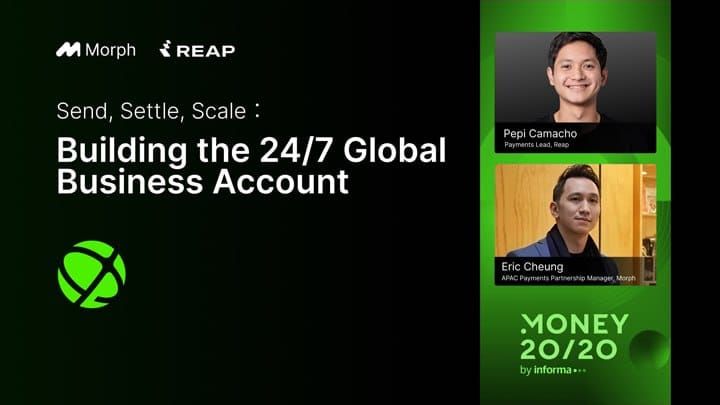
Send, Settle, Scale: Building the 24/7 Global Business Account
At the heart of the bustling Money 20/20 Asia floor in Bangkok, the conversation shifted from the theoretical to the practical. While much of the industry discusses "the future of finance," Eric Cheung (APAC Payments Partnership Manager, Morph) and Pepi Camacho (Payments Lead, Reap) sat down to discuss the actual plumbing being built right now.
The consensus? The gap between crypto-native needs and legacy banking is finally closing, powered by stablecoins, AI, and a localized approach to emerging markets.
Here are the four key insights from their fireside chat.
1. Solving the "Web3 Banking Gap" with Reap Direct
The biggest hurdle for any Web3 founder isn't the tech; it's the banking. Traditional institutions often view crypto-native projects with a level of scrutiny that makes simple tasks like paying for a SaaS subscription or a team dinner, nearly impossible.
Pepi highlighted how Reap Direct acts as the interim (and often permanent) solution for these businesses.
- The Dashboard Effect: Managing all finances, from card issuance to payroll in a single view.
- Stablecoin Payroll: Facilitating salary payments in USDC that land directly in employees' traditional bank accounts.
- Infrastructure as a "Catapult": Allowing small teams to operate with the financial weight of a much larger corporation.
2. The Rise of the "Agentic" Back Office
Eric noted that today’s startups are leaner than ever. In this "lean" era, the back office can’t afford to be a bottleneck. Pepi’s vision for the future of corporate finance involves AI-powered workflows.
"Using AI to streamline workflows means a CEO can also be a CFO and a finance manager all in one," Pepi noted. "His hair might turn gray after a couple of years, but that’s the stage we’re trying to get to: making everything agentic in nature."
By automating the "boring" parts of finance like compliance checks, reconciliation, and expense management, founders can focus on building, not bookkeeping.
3. Beyond the Hype: Winning in Emerging Markets
Global expansion is often discussed in broad strokes, but Reap’s strategy is boots-on-the-ground. While they are anchored in Hong Kong and Singapore, the focus has shifted to LATAM and Africa.
Key takeaway for builders: You cannot win globally without local licensing. Reap isn't just setting up entities; they are collaborating with local banks and securing licenses to ensure their payment services are compliant and deeply integrated into the local economy.
4. The $76 Trillion Opportunity: From Settlement to Yield
Eric shared a staggering figure: stablecoin payments reached approximately $76 trillion in early 2026. While that is massive, it’s still just a fraction of the global payment volume.
The next frontier? Yield. Reap is moving beyond being just a "settlement layer" or a way to unlock fiat. They are exploring ways for businesses to earn yield on idle assets sitting within their platform.
"Competition is good," Pepi said, referencing the rise of DeFi card initiatives like Rain Fi. "We don’t want to just be the fiat-unlock layer... we want clients to view us as a platform where they can use us for everything, from the yield side to the spend side."
The Verdict: Execution is the New Exploration
If 2025 was the year of banks "exploring" stablecoins, 2026 is the year of execution. As Eric observed, the exhibitors at Money 20/20 this year weren't just talking about pilots, they were showcasing live institutions and banks actually executing onchain.
For Morph and Reap, this convergence of traditional finance and digital assets isn't just a trend; it's the infrastructure for the next decade of global commerce.
Quick Stats from the Session:
- Top Revenue Driver: Card issuance remains Reap’s primary growth engine.
- Focus Markets: LATAM and Africa are the high-priority expansion targets.
- Market Sentiment: Stablecoin awareness among traditional banks has shifted from "curiosity" to "active execution."