Broken by Design: Why Payroll Still Moves Too Slowly
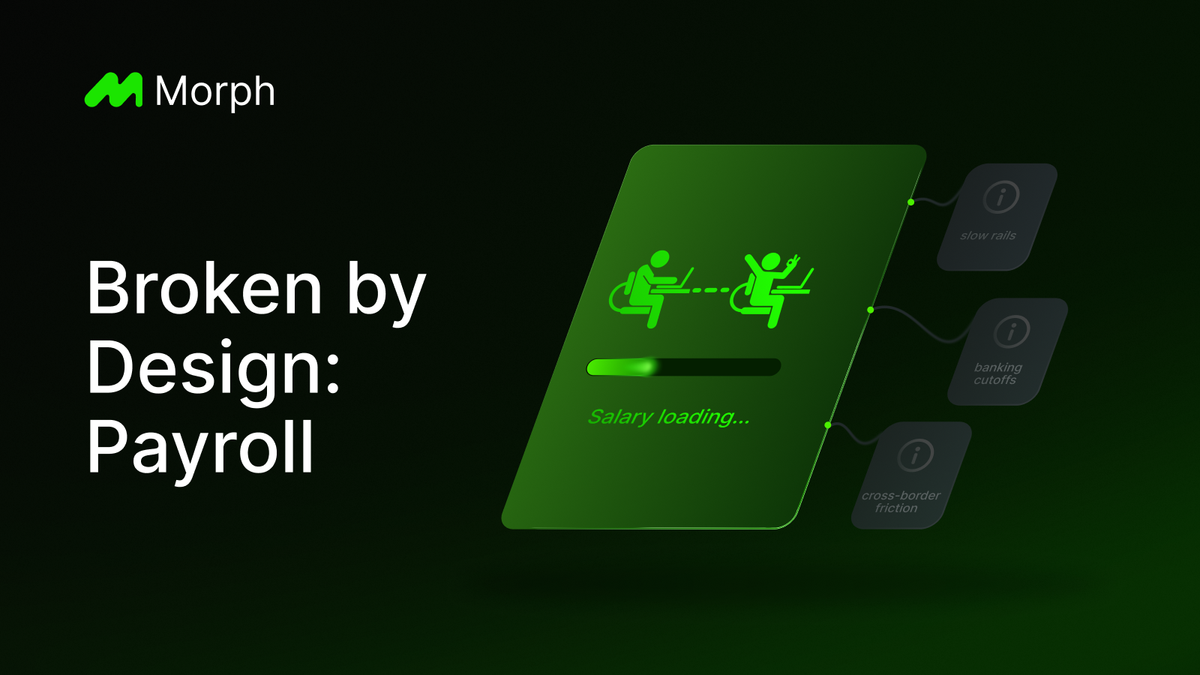
People work in real time. Payroll still doesn’t.
For something so central to daily life, getting paid remains tied to a system that moves too slowly, costs too much across borders, and still depends on banking schedules that do not reflect how modern work actually happens.
That is especially obvious in cross-border payroll, where employers, contractors, and distributed teams all feel the drag of a payment system built around cutoffs, batch processing, correspondent relationships, and fragmented local payout rails.
This is often treated as a minor inconvenience. It is not.
Payroll is one of the clearest examples of how legacy payment infrastructure still shapes financial outcomes long after the work itself is done.
The Gap Between Work and Payment
Most modern businesses operate continuously.
Teams work across time zones. Contractors contribute from different countries. Global companies hire wherever talent lives. Freelancers finish projects at night, on weekends, and across borders.
But payroll infrastructure still assumes a slower world.
Funds are often processed in batches. Banks operate on business-day schedules. Cross-border transfers move through multiple institutions. Cutoff times and local banking windows determine when value actually lands.
The result is a basic mismatch: work happens in real time, but payment still depends on older rails.
That mismatch creates friction for everyone involved.
Why Payroll Still Feels Broken
Payroll problems are usually described as operational or administrative. In reality, many of them are settlement problems.
The core issues are familiar:
- banking-hour dependency
- weekend and holiday delays
- fragmented cross-border payout paths
- FX spreads and intermediary fees
- slow access to usable funds
- uncertainty around timing and arrival
For employers, that means more complexity in running distributed teams and more overhead in moving money across borders.
For workers, it means waiting for income that has already been earned.
For contractors and freelancers, especially those being paid internationally, it often means receiving less than expected and later than expected.
That is not just inefficient. It is a poor fit for how work is increasingly organized.
Cross-Border Payroll Makes the Problem Worse
The cracks become more obvious when payroll crosses borders.
A domestic payroll delay is frustrating. A cross-border delay adds:
- more institutions
- more handoffs
- more compliance steps
- more currency conversion
- more uncertainty
In many cases, the worker on the receiving end has no visibility into where the delay occurred. They only know the funds have not arrived yet.
The employer may have “sent the payment,” but that does not mean the worker can use it.
That is the core issue. A payment is not complete when it leaves one system. It is complete when it becomes usable for the person who earned it.
Legacy rails still make that too slow.
The Hidden Cost of Slow Payroll
Payroll friction is not just about waiting.
It also carries hidden costs across the flow:
- employers spend more time coordinating payout operations
- workers lose value to fees and FX spreads
- treasury movement becomes harder to predict
- global teams face avoidable financial stress
- businesses absorb inefficiency that should not be there
This is particularly damaging in markets where people rely on frequent payouts, contractor work, or income from abroad.
When payroll is delayed, the cost is not theoretical. It lands directly in real life.
Why Stablecoin Rails Matter for Payroll
Stablecoins matter in payroll because they offer a more direct way to move value across borders.
Instead of relying on multiple institutionally fragmented rails before funds become usable, stablecoin-based payment flows can reduce layers in the middle and make settlement happen faster, with fewer dependencies on banking hours and local payout bottlenecks.
That changes the shape of the payroll flow.
A better payroll rail can mean:
- faster settlement
- more predictable timing
- fewer intermediary deductions
- less friction across borders
- simpler payout operations for employers
- quicker access to funds for workers
That does not solve every payroll problem on its own. But it solves one of the most important ones: the movement of value itself.
What Better Payroll Infrastructure Looks Like
A modern payroll system should not ask:
- which bank window is open
- whether Monday needs to come first
- how many intermediaries sit in the path
- whether the recipient will lose value across the route
It should simply move earned money to the person who earned it.
That means payroll infrastructure should be:
- always on
- predictable
- efficient across borders
- legible to both employer and worker
- less dependent on fragmented institutional rails
This is where payment infrastructure starts to matter more than interface design or payroll software branding.
The real bottleneck is often underneath the workflow.
How Morph Helps Improve the Flow
Morph is built around a simple idea: payment infrastructure should match how money actually needs to move.
That matters in payroll because payroll is one of the clearest places where timing, cost, and settlement quality directly affect everyday outcomes.
Morph helps improve this in a few important ways.
Faster Settlement for Real Payment Flows
Payroll should not be delayed by systems that only move efficiently during banking windows.
Morph is built for high-volume payment flows with faster settlement and infrastructure designed to support real movement of value, not just abstract transaction activity.
That creates a stronger foundation for payroll products and cross-border payout systems that need more predictable settlement.
Stablecoin-Native Movement
Stablecoins are increasingly central to real-world payment activity, especially for cross-border movement of value.
Morph’s payment-oriented stack is designed to support stablecoin settlement directly, making it easier to build payroll and payout systems around assets that are legible, usable, and better suited for faster movement.
Lower Friction Across Borders
Cross-border payroll becomes harder when value has to move through too many intermediaries.
Morph’s broader ecosystem approach - including stablecoins, wallet infrastructure, bridge access, and payment-focused partners - helps reduce the friction around how funds enter, move through, and exit the network.
That matters for payroll because getting funds from source to recipient cleanly is the whole point.
Better Economics for Employers and Workers
Better rails do not just improve speed. They improve the economics of the system.
For employers, that can mean simpler global payout operations and less settlement drag.
For workers, that can mean faster access, better transparency, and less value lost before payment lands.
That is the kind of improvement payroll infrastructure should aim for.
The Bigger Point
Payroll is one of the oldest and most essential payment flows in the world.
It should not still feel this dependent on delay. And yet, across borders especially, it often does. That is not because the demand is unclear. People will always need to get paid.
It is because the rails underneath payroll were not built for a world of always-on digital work, distributed teams, and global movement of labor.
That is why payroll is not just a payroll software problem. It is a settlement problem.
Conclusion
Payroll still moves too slowly because the infrastructure behind it still depends on batching, banking hours, fragmented handoffs, and cross-border complexity.
For workers, that means waiting. For employers, that means drag.
For the system as a whole, it means payroll still behaves more slowly than the world of work it is supposed to support.
That no longer makes sense.
As work becomes more global and more continuous, payroll needs better rails underneath it.
The better those rails get, the closer payment gets to the speed of work itself.
And that is the real opportunity.