
Introducing Morph Tachyon, a trading L1 built for speed

In 1967, physicist Gerald Feinberg gave a name to a particle that should not exist. He called it the tachyon, from the Greek tachys, meaning swift. A tachyon travels faster than light. It has never been observed, because by definition, it arrives before anything can catch it. Science fiction has been borrowing it ever since, whenever a story needs something faster than the universe allows.
That is the standard we set for our new chain.
Today, we introduce Morph Tachyon, a high-performance Layer 1 designed for onchain trading. This is what it is, why trading needs its own chain, and what this means for the Morph ecosystem.
What is Morph Tachyon
Onchain traders now expect the throughput, finality, and execution experience of centralized trading venues, without giving up the transparency and self-custody that brought them onchain.
Morph Tachyon is a dedicated Layer 1 built from the ground up to meet that standard. Every part of the chain is tuned for the high-frequency trading workload, from order submission and cancellation to matching, position management, and oracle updates.
Core specifications:
- 200ms block times and up to 200,000 TPS
- Gas-free transactions
- Instant finality with no block reorgs, powered by a proprietary variant of HotStuff BFT
- Custom EVM-compatible architecture, so standard EVM wallets, address formats, JSON-RPC, and developer tools all work out of the box
Why trading needs a dedicated chain
Consider what a live onchain order book asks of a blockchain. Every time the price moves, market makers cancel quotes and place new ones across every market they serve. Top that off with transactions from traders, and the active order book generates a transaction stream that must be matched deterministically and settled with finality that is instant and irreversible.
General-purpose chains were never built to absorb this. Teams building onchain markets have long faced a choice between two compromises. Execute matching offchain and settle onchain, which sacrifices the transparency that makes the market worth putting onchain in the first place. Or build on shared blockspace, where cancellations queue behind unrelated transactions and performance degrades at the exact moments volatility makes it matter most. A third path, building a high-performance chain, has been open only to teams with the resources to run their own infrastructure.
Morph Tachyon is that third path, offered as open infrastructure. It is a trading-native execution engine: a Layer 1 where block production, matching, and state are engineered specifically for the order book from the start. That base-layer performance realizes the possibility of running fully onchain order books with transparent price discovery, and order flow execution that rivals centralized venues while traders keep custody of their assets.
The infrastructure is open to next-generation trading platforms, market makers, liquidity providers, and ecosystem partners building high-performance onchain markets. Major ecosystem partners building on Morph Tachyon will be announced imminently.
One ecosystem, dual architecture
Morph Tachyon expands the Morph ecosystem with each chain engineered for what it does best.
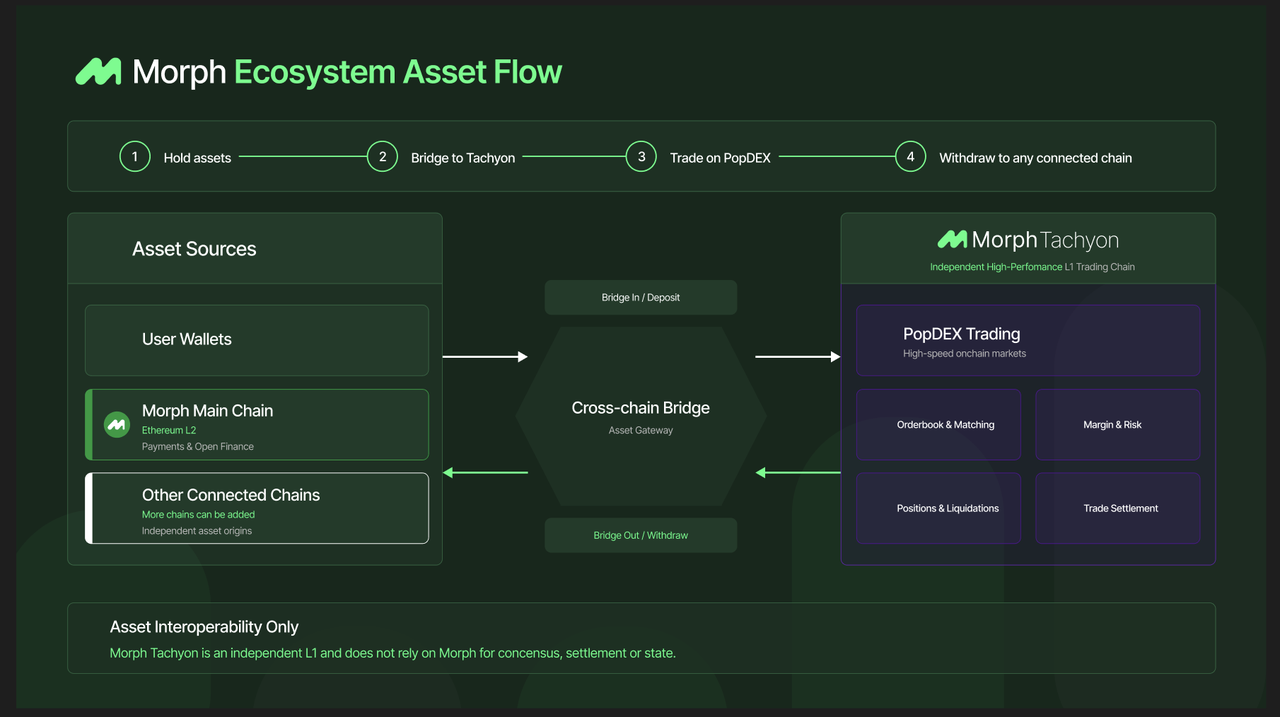
Morph is built for money movement on a global scale, where security, low transaction costs, and reliable settlement matter most. The main chain serves as the primary major liquidity layer for Tachyon. Assets that settle on Morph move natively into Tachyon markets, and value that enters the ecosystem through payment rails now has a venue where it can be productively put to work.
The two chains are built for native integration, and that is where the architecture compounds. Ecosystem partners benefit immensely from the interoperability and composability that this dual architecture offers: stablecoins settled on Morph can serve as margin on Tachyon markets, lending markets can source yield from trading activity, and vault strategies can route capital into onchain markets and back. Capital in the ecosystem stays productive. Balances that would otherwise sit idle on settlement rails have a native path into markets, and yield generated in markets flow back into open finance on Morph. Morph sits at the home base of the liquidity flow that enters Tachyon markets from across crypto.
Under the hood, Morph Tachyon runs its own consensus mechanism, purpose-built for trading. A sub-second block time with instant finality demands an engine of its own, and giving trading a dedicated one is precisely what we believe onchain traders deserve.
The result is an ecosystem that now spans the full range of onchain finance. Users can pay and settle on one side, trade and invest in the other, and never leave Morph.
What Tachyon means for BGB
Morph is the home of BGB, and the ecosystem built around BGB is expanding. Morph serves as the primary liquidity layer for Tachyon, which places BGB at the center of everything that flows through the new architecture. Every trading application that launches on Tachyon, every market that opens, and every unit of liquidity moves through an ecosystem with BGB at its core.
As a native asset of the liquidity layer, BGB moves into Tachyon markets the way any Morph asset does, where trading applications can put it to work. Utility that began in payments and open finance now has a trading environment to expand into, and as platforms, market makers, and ecosystem partners build on Tachyon, the surface area for BGB grows with the network.
Ahead of everything else
A tachyon arrives before anything can catch it. So does every trade on Tachyon. Confirmed, final, no waiting.
The name also carries a second meaning. In physics, a tachyon shows up at the moment something is about to morph into a new form, like water on the edge of becoming ice.Physics never found the tachyon. So we built one.
Stay tuned as we announce more details and updates on Morph Tachyon and its ecosystem partners in coming weeks. Learn more about Morph at morph.network.