How to Pay Freelancers and Agencies With Stablecoins
Global work should not depend on slow, costly payment rails. Morph Payments lets businesses pay freelancers and agencies in USDC or USDT—individually or in bulk, directly to their wallets.


Businesses can use Morph Payments to pay international freelancers, contractors and agencies in USDC or USDT. Payments can be sent individually or in bulk, settle directly into recipients’ wallets, and remain tracked in one dashboard.
The way people work has changed. The way many of them get paid has not.
The World Bank estimates that between 154 million and 435 million people undertake online gig work globally. They design, build, write and code for clients in other countries, yet their payments may still depend on correspondent banks, currency conversion and settlement windows measured in business days.
For businesses working with distributed freelancers and agencies, this creates more than a payment inconvenience. It increases costs, complicates reconciliation and generates repeated questions about when payments will arrive.
What are stablecoin payments for freelancers?
Stablecoin payments allow businesses to pay freelancers and contractors using digital currencies designed to maintain a stable value, such as USDC and USDT.
Instead of sending money through several banks and payment intermediaries, the business sends stablecoins directly to the recipient’s compatible wallet. Transactions can settle at any time of day without waiting for banking hours.
This can be particularly useful when:
- A company regularly pays freelancers in several countries.
- An agency needs to pay remote collaborators or suppliers.
- A marketplace makes payouts to multiple sellers or creators.
- A business already receives or holds revenue in stablecoins.
- Traditional payment routes are slow, expensive or difficult to reconcile.
Stablecoins do not remove every source of payment friction. Availability, network fees, wallet support, local regulation and conversion into national currencies vary by jurisdiction. But for businesses and recipients that can use them, stablecoins provide a more direct alternative to conventional cross-border payment rails.
Why use stablecoins to pay international freelancers and contractors?
Traditional cross-border payments can involve transaction charges, foreign-exchange markups and intermediary-bank fees. The final cost depends on the countries, currencies, banks and platforms involved.
Fees can also compound. A freelancer may first pay a commission to the platform through which the work was secured, followed by payment-processing or currency-conversion charges when withdrawing the remaining balance.
For a detailed comparison of international wire, PayPal, Wise and stablecoin costs, read The True Cost of Getting Paid From Abroad
Settlement time creates another cost. While a payment is in transit, the recipient cannot use the funds, and the business may have limited visibility into where the payment is. Finance teams then spend time checking transaction statuses and responding to payment queries.
Stablecoins can simplify this process by allowing funds to move directly between compatible wallets. They can also give both parties a verifiable onchain transaction record.
How do you pay freelancers using Morph Payments?
Morph Payments lets businesses send individual or bulk stablecoin payouts without managing payments one wallet at a time.
The process involves four main steps:
- Create an account using an email address.
A secure, non-custodial wallet is created as part of the setup, without requiring the user to manage a seed phrase. - Add the payment recipients.
Businesses can add an individual recipient or upload multiple recipients for a bulk payout. - Choose the stablecoin and review the details.
Payments can be sent in supported stablecoins, including USDC and USDT. - Authorise and track the payments.
Once sent, each payment remains visible in the Morph Payments dashboard with a verifiable transaction record.
This turns contractor payouts into a repeatable business workflow rather than a collection of manual wallet transfers.
What does Morph Payments provide for global teams?
Individual and bulk stablecoin payouts
Businesses can pay one recipient or multiple freelancers, agencies, contractors and suppliers in the same workflow.
Bulk payouts reduce the need to prepare and authorise a separate payment for every recipient. This is particularly useful for agencies, marketplaces and companies working with distributed teams.
One place to track every payment
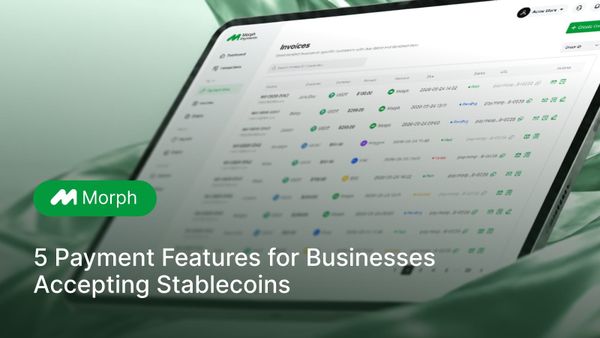
Incoming and outgoing payments are recorded in a single dashboard.
Instead of reconstructing the month’s activity from wallet addresses, transaction hashes and separate spreadsheets, finance teams can review their stablecoin payments from one place.
Non-custodial control of funds
Morph Payments does not hold customer funds. Businesses retain control of their money through their own wallet rather than maintaining a balance held by the platform.
This means there is no separate platform-controlled payout window determining when the business can access its funds.
Network fees paid in stablecoins
Users do not need to acquire a separate blockchain gas token before making a payment. Applicable network fees can be paid in stablecoin, removing an additional step from the payout process.
Businesses should still review the current fee information before authorising a transaction.
Transaction screening and audit trails
Morph Payments screens transactions and provides audit trails and verifiable payment records.
These features can support a business’s transaction-monitoring, accounting and record-keeping processes. They do not replace the company’s responsibility to comply with applicable employment, tax, sanctions and reporting requirements in the jurisdictions where it operates.
Got more questions? Check out our Help Centre.
Who can benefit from bulk stablecoin payouts?
Morph Payments is designed for businesses that make frequent payments across borders, including:
- Agencies paying international freelancers and subcontractors
- Companies working with distributed contractor teams
- Marketplaces paying sellers or service providers
- Creator platforms distributing earnings
- Web3 companies paying contributors and suppliers
- Online businesses managing recurring international payouts
The more recipients and payment corridors a business manages, the more valuable a consolidated payout and reconciliation process can become.
Setting up your Morph Payments account is intuitive and quick. Complete the required onboarding to start paying your contractors and partners. Sign up now or request a demo.