10 Best Stablecoin Payment Platforms for Businesses

For many internet businesses, accepting stablecoins is no longer the biggest challenge. Managing those payments efficiently is.
Gaming and gift card platforms need to confirm payments and fulfil orders. Collectibles marketplaces need integrated checkout. Blockchain ecosystem teams need to pay contributors worldwide, while agencies need to collect client invoices and pay contractors.
As transaction volumes grow, manually verifying wallet transactions, matching payments to orders and managing outgoing payments become increasingly inefficient.Stablecoin payment platforms help businesses streamline these operations without building their own payment infrastructure. However, different providers serve different business needs, from online checkout and invoicing to enterprise financial infrastructure.
This guide compares ten leading stablecoin payment platforms based on their capabilities, pricing, custody models, integration options and suitability for different industries.
TL;DR: The 10 Best Stablecoin Payment Platforms
- Morph Payments: Best for internet businesses that accept and send stablecoins with 0% platform fees.
- Coinbase Business: Best for eligible businesses seeking a crypto-enabled business account.
- Stripe: Best for existing Stripe merchants adding stablecoin payment acceptance.
- Request Finance: Best for invoicing, accounts payable and contractor payments.
- BitPay: Best for established merchants requiring flexible crypto and fiat settlement.
- NOWPayments: Best for businesses accepting a wide range of cryptocurrencies.
- BVNK: Best for high-volume enterprise stablecoin payment infrastructure.
- Triple-A: Best for enterprises accepting digital currencies while settling in fiat.
- CoinGate: Best for e-commerce businesses requiring flexible crypto payment integrations.
- AllScale: Best for self-custodial online payments and small business invoicing.
1. Stablecoin Payment Platforms Compared
Commercial Comparison
Platform | Best for | Merchant settlement | Custody model | Published pricing |
Morph Payments | Internet businesses & digital commerce | Stablecoins | Self-custodial | 0% platform fee |
Coinbase Business | Crypto-enabled business accounts | Crypto and fiat | Provider-managed account | Product-dependent |
Stripe | Existing Stripe merchants | Stripe balance | Provider-managed processing | 1% standard rate |
Request Finance | Business finance operations | Crypto and fiat | Product-dependent | Plan and service-dependent |
BitPay | Established merchants | Crypto, fiat or both | Provider-managed processing | 1–2% + $0.25 |
NOWPayments | Multi-cryptocurrency acceptance | Cryptocurrency | Service-dependent | Service-dependent |
BVNK | Enterprise payment infrastructure | Crypto and fiat | Provider-managed infrastructure | Custom pricing |
Triple-A | Enterprise commerce | Fiat currencies | Provider-managed processing | Custom pricing |
CoinGate | E-commerce merchants | Crypto or fiat | Provider-managed processing | 1% standard processing fee |
AllScale | Online businesses and professionals | Stablecoins | Self-custodial | 0.6% standard checkout fee |
Payment Capabilities Comparison
Platform | Payment collection | Outgoing payments | Integration |
Morph Payments | Invoices, payment links, hosted checkout | Single and batch stablecoin payouts | API and webhooks |
Coinbase Business | Payment links, invoices and checkout | Crypto transfers | Developer tools and APIs |
Stripe | Checkout and payment links | Stripe ecosystem payout tools | API, SDKs and plugins |
Request Finance | Client invoicing | Crypto payouts | Accounting and finance integrations |
BitPay | Merchant checkout and invoicing | Crypto payout services | API and merchant integrations |
NOWPayments | Checkout, invoices and payment tools | Mass payouts | API and merchant integrations |
BVNK | API-based payment collection | Global payouts | Enterprise APIs and webhooks |
Triple-A | Merchant payment acceptance | Global payouts | Enterprise API |
CoinGate | Checkout, invoices and plugins | Crypto payouts | API and e-commerce plugins |
AllScale | Checkout and invoicing | Payment and claim-link tools | API integration |
Pricing, supported assets, geographic availability and product capabilities may change. Collection and payout features may be offered through separate products or subject to additional eligibility requirements. Network fees, conversion charges and other service costs may apply.
2. How We Evaluated These Stablecoin Payment Platforms
A stablecoin payment platform should be evaluated across the entire business payment workflow, not just its transaction fees or supported currencies.
Payment stage | Key questions |
Collect | How can customers pay? Does the platform support invoices, payment links, checkout or API-based payments? |
Identify | Can businesses automatically match incoming payments to customers, orders and invoices? |
Control | Where do funds settle? Who controls the assets? Can businesses retain stablecoins or convert them into fiat? |
Distribute | Can businesses use their funds to pay suppliers, contractors, contributors and other recipients? |
We also considered pricing, integration requirements, supported networks, geographic availability and industry suitability.The providers in this guide generally fall into three categories:
- Stablecoin-native business payment platforms: Morph Payments and AllScale, designed for businesses that already transact in stablecoins.
- Merchant payment gateways: Morph Payments, Stripe, BitPay, NOWPayments, Triple-A and CoinGate, focused on introducing digital currency acceptance into commerce operations.
- Business finance and enterprise infrastructure: Coinbase Business, Request Finance and BVNK, addressing broader financial management and money movement requirements.
These categories overlap, and the right solution depends on your business model.Platforms were selected based on market presence, product capabilities and business relevance. The comparison is based on publicly available product information rather than independent hands-on testing, and the order does not represent an absolute ranking of product quality.
3. The 10 Best Stablecoin Payment Platforms for Businesses
1. Morph Payments — Best For Internet Businesses That Accept And Send Stablecoins
Official website | Payment solutions | Payout Solution | Developer documentation
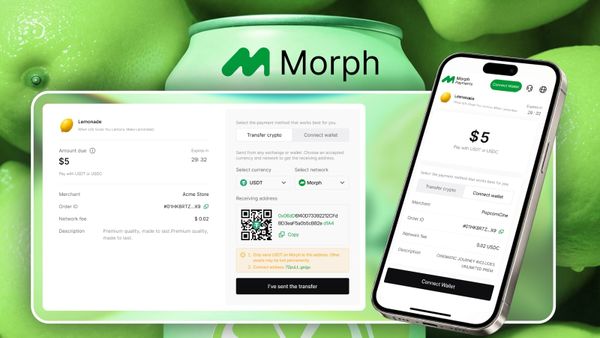
Morph Payments is a self-custodial stablecoin payment platform designed for internet businesses that want to collect, manage and send stablecoins without building their own payment infrastructure.It is particularly suitable for gaming and gift card platforms, digital goods marketplaces, collectibles platforms, crypto-native applications, blockchain ecosystem teams, agencies and online service providers.Businesses can create payment links and invoices, integrate stablecoin checkout into websites and applications, and send individual or batch payments through one platform.Customers can pay in supported stablecoins from their existing wallets or compatible exchanges, while businesses retain control of their assets through self-custodial wallets.
Key features
- USDT and USDC acceptance across supported blockchain networks.
- Payment links, invoices and hosted checkout.
- APIs and webhooks for payment integration and automated confirmation.
- Single and batch stablecoin payouts.
- Self-custodial wallets with hardware-isolated key protection.
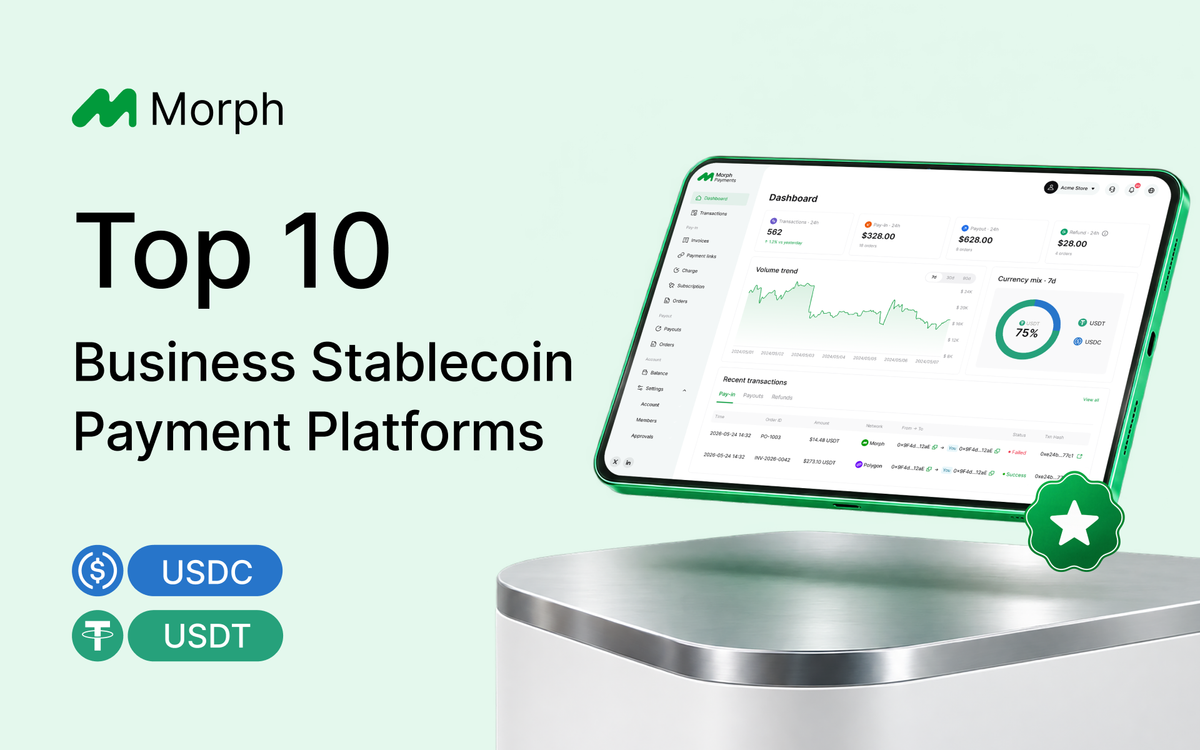
- Centralised payment and transaction tracking.
Pricing: 0% platform fees, with no setup fees or monthly minimums. Blockchain network fees and applicable third-party service charges may apply.
Advantages
- No percentage-based platform processing fees.
- Businesses retain control of their funds.
- Incoming and outgoing payments within one platform.
- No-code payment tools and developer integration options.
- Particularly relevant to businesses processing frequent transactions.
Considerations: Morph Payments focuses on stablecoin-native payment workflows. Businesses requiring traditional card acquiring, comprehensive payroll administration or extensive fiat banking infrastructure may need complementary services.
Get started with Morph Payments.
2. Coinbase Business — Best For Crypto-Enabled Business Accounts
Coinbase Business combines crypto-enabled financial services with tools for accepting, sending and managing digital assets.
Key features
- Crypto-enabled business accounts.
- Payment links, invoices and checkout.
- Cryptocurrency transfers and conversion.
- Developer integration tools.
Pricing: Product-dependent.
Advantages: Access to the broader Coinbase ecosystem, combining payment functionality with account management and conversion services.
Considerations: Uses a provider-managed account model. Product availability, fees and business eligibility vary by jurisdiction.
3. Stripe — Best For Existing Stripe Merchants
Stripe enables eligible businesses to accept stablecoins alongside traditional payment methods through its existing payment infrastructure.
Key features
- Stablecoin payment acceptance.
- Hosted checkout and payment links.
- Developer APIs and SDKs.
- Integration with the broader Stripe payment ecosystem.
Pricing: Published standard stablecoin processing rate of 1%, with promotional pricing available during specified periods.
Advantages: Established payment infrastructure, extensive developer tools and integration with existing merchant operations.
Considerations: Merchant eligibility and geographic restrictions apply. Businesses requiring direct self-custodial stablecoin settlement should evaluate alternative arrangements.
4. Request Finance — Best For Invoicing And Business Finance Operations
Request Finance helps businesses manage financial operations across stablecoins and traditional currencies, with a focus on invoicing, accounts payable and outgoing payments.
Key features
- Client invoicing.
- Contractor and vendor payments.
- Batch payment workflows.
- Payment approvals.
- Accounting and finance integrations.
Pricing: Plan and service-dependent.
Advantages: Comprehensive financial management tools and structured workflows for finance teams.
Considerations: Businesses primarily seeking website checkout or lightweight payment collection may not require its broader financial management capabilities.
5. BitPay — Best For Merchants Requiring Flexible Settlement
BitPay is an established cryptocurrency payment processor that enables merchants to accept digital currencies and settle funds in supported cryptocurrencies or traditional currencies.
Key features
- Cryptocurrency payment acceptance.
- Merchant invoicing.
- Fiat and cryptocurrency settlement.
- Retail payment tools and reporting.
Pricing: Published processing fees range from 1% to 2%, plus $0.25 per transaction, depending on monthly volume. Certain industries may incur higher fees.
Advantages: Established merchant infrastructure and flexible settlement arrangements.
Considerations: Fixed and percentage-based transaction fees can be significant for frequent, low-value purchases.
6. NOWPayments — Best For Multi-Cryptocurrency Acceptance
NOWPayments enables businesses to accept a broad range of cryptocurrencies, including stablecoins, through merchant payment tools and API-based integrations.
Key features
- Broad cryptocurrency acceptance.
- Payment APIs and merchant tools.
- Cryptocurrency conversion.
- Mass payouts.
- E-commerce integrations.
Pricing: Service-dependent, with fees varying by payment and conversion arrangements.
Advantages: Extensive cryptocurrency coverage and flexible merchant integration options.
Considerations: Businesses should evaluate conversion costs and distinguish direct payment acceptance from custody-based services.
7. BVNK — Best For Enterprise Stablecoin Payment Infrastructure
BVNK provides enterprise payment infrastructure for collecting, holding, converting and distributing funds across stablecoins and traditional currencies.
Key features
- Stablecoin payment collection.
- Global payouts.
- Fiat and stablecoin accounts.
- Currency conversion.
- Enterprise APIs and webhooks.
Pricing: Custom commercial arrangements.
Advantages: Comprehensive infrastructure connecting traditional and stablecoin payment systems.
Considerations: Primarily targets established, high-volume businesses, with qualification requirements relating to payment volumes and operating history.
8. Triple-A — Best For Enterprise Commerce And Fiat Settlement
Triple-A helps businesses accept digital currencies while maintaining traditional financial settlement processes.
Key features
- Digital currency payment acceptance.
- Enterprise API integration.
- Global payout services.
- Configurable payment experiences.
- Local currency settlement.
Pricing: Custom commercial arrangements.
Advantages: Businesses can reach crypto-paying customers without directly managing cryptocurrency balances.
Considerations: Geographic coverage, onboarding requirements and commercial terms should be evaluated for each operating market.
9. CoinGate — Best For E-Commerce Crypto Payments
CoinGate helps merchants accept cryptocurrency payments through online checkout, e-commerce integrations and invoicing tools.
Key features
- Cryptocurrency checkout.
- E-commerce plugins and APIs.
- Email invoicing.
- Crypto payouts.
- Currency conversion and reporting.
Pricing: 1% standard payment processing fee. Additional service charges may apply.
Advantages: Flexible e-commerce integrations, broad cryptocurrency support and settlement options.
Considerations: Businesses should evaluate total processing, conversion and withdrawal costs.
10. AllScale — Best For Self-Custodial Online Payments And Small Business Invoicing
AllScale provides stablecoin-powered financial tools for online businesses, independent professionals and platforms.
Key features
- Stablecoin checkout and invoicing.
- Self-custodial wallets.
- API integration.
- Claim links and payment tools.
- Eligible card-funded payment options.
Pricing: 0.6% published standard checkout fee. Additional services may carry separate charges.
Advantages: Accessible payment tools and self-custodial settlement for online businesses.
Considerations: Businesses should evaluate checkout fees, banking services and additional payment methods separately.
4. Best Stablecoin Payment Platforms by Payment Needs
The right stablecoin payment platform depends on whether your business primarily needs payment collection, payouts or broader financial operations.
Payment requirement | Platforms to consider | Key evaluation criteria |
Online checkout | Morph Payments, NOWPayments, CoinGate | Payment confirmation, fees, checkout experience |
Payment links and invoicing | Morph Payments, Request Finance, AllScale | Invoice creation, payment tracking, ease of use |
Contractor and vendor payouts | Morph Payments, Request Finance, BVNK | Batch payments, transaction records, payout costs |
API-based payment integration | Morph Payments, AllScale, Stripe, BVNK | APIs, webhooks, documentation, integration effort |
Self-custodial stablecoin payments | Morph Payments, AllScale | Wallet ownership, fund control, security |
Multi-cryptocurrency acceptance | NOWPayments, CoinGate, BitPay | Supported currencies, networks, conversion |
Fiat settlement | Triple-A, Stripe, BitPay, BVNK | Settlement currencies, conversion costs, geo coverage |
Financial operations and payable | Request Finance, Coinbase Business | Approval workflows, financial records, account services |
Enterprise payment infrastructure | BVNK, Triple-A | Scalability, liquidity, compliance and settlement coverage |
For businesses that both receive and send stablecoins, using a unified payment platform can reduce the need to move funds between separate wallets and payment tools.
5. Best Stablecoin Payment Platforms by Industry
Gaming, Gift Card And Digital Goods Platforms
Platforms to consider: Morph Payments, AllScale, NOWPayments, CoinGate and Triple-A.
Gaming top-up platforms, gift card marketplaces and digital goods businesses often process frequent, relatively low-value transactions. Processing fees, payment confirmation and automated fulfilment are therefore particularly important.
A typical payment workflow involves:
- A customer purchases a gaming top-up, gift card or digital product.
- The customer pays in USDT or USDC.
- The payment platform confirms the transaction.
- The merchant's system matches the payment to the order and fulfils the purchase.
Morph Payments supports this workflow through hosted checkout, APIs and payment-status webhooks, with 0% platform fees.
NOWPayments and CoinGate offer broader cryptocurrency acceptance, while Triple-A is an alternative for enterprises requiring fiat settlement.
Collectibles And Digital Asset Marketplaces
Platforms to consider: Morph Payments, AllScale and NOWPayments.
Marketplaces for trading cards, virtual collectibles and digital assets need to connect customer payments with orders, account balances and outgoing payments.
Morph Payments provides stablecoin checkout, payment APIs and single or batch payouts that marketplace operators can incorporate into their existing systems.
Its self-custodial model also enables businesses to retain control of their stablecoin balances.
Operators requiring escrow, automated revenue splitting, seller onboarding or dedicated deposit infrastructure should evaluate those capabilities separately.
Crypto-Native Platforms And Applications
Platforms to consider: Morph Payments, Coinbase Business and BVNK.
Blockchain analytics platforms, trading tools, entertainment applications and developer services often serve customers who already hold digital assets.
Their challenge is not necessarily introducing stablecoins, but improving how existing payments are collected, identified and managed.
Morph Payments offers APIs and webhooks for integrating payment collection into websites and applications.
For example, PopcornCine completed its Morph Payments integration in one day, demonstrating how businesses can introduce stablecoin payment functionality without developing their own payment infrastructure from scratch.
Integration timelines vary depending on technical requirements and existing systems.
Blockchain Protocols, Foundations And Ecosystem Teams
Platforms to consider: Morph Payments, Request Finance and Coinbase Business.
Blockchain ecosystem organisations frequently pay developers, contributors, community managers, marketing partners and other service providers across different markets.
Morph Payments enables teams to send individual and batch stablecoin payouts, maintain transaction records and retain control over their assets through self-custodial wallets.
Request Finance is an alternative for organisations requiring more comprehensive accounts payable, approval and financial administration capabilities.
Agencies, Freelancers And Professional Services
Platforms to consider: Morph Payments, Request Finance and AllScale.
Agencies and professional service providers often receive stablecoins from clients and subsequently use those funds to pay contractors, freelancers and suppliers.
Morph Payments combines client invoicing, payment links and batch payouts within one platform, reducing the need for separate payment tools and fragmented transaction records.For example, XPR.Group, an international PR and marketing agency operating in the crypto ecosystem, uses Morph Payments to streamline its stablecoin payment operations.
Read the full case study: How XPR.Group streamlines its agency operations with Morph Payments.
AI, Software And Infrastructure Providers
Platforms to consider: Morph Payments, AllScale and Stripe.
AI API resellers, software businesses, cloud infrastructure providers and developer services often operate prepaid credit, usage-based or service fee models.
For example, an AI API reseller could integrate stablecoin checkout to allow customers to purchase usage credits. Once payment is confirmed, the reseller's own system can update the customer's available balance.
Morph Payments supports these workflows through payment links, hosted checkout, APIs and payment-status notifications.
Stripe may be more suitable for businesses requiring traditional payment processing or extensive subscription billing infrastructure.
E-Commerce And Online Retail
Platforms to consider: Stripe, Triple-A, CoinGate and BitPay.
Traditional online retailers may want to accept stablecoins without changing their existing financial operations.
These businesses should prioritise fiat settlement, e-commerce plugins, currency conversion and compatibility with existing payment systems.
Businesses that prefer to retain stablecoins for operational payments may also consider stablecoin-native alternatives such as Morph Payments.
Financial Institutions And Payment Service Providers
Platforms to consider: BVNK, Triple-A and Coinbase Business.
Financial institutions and payment service providers typically require more extensive infrastructure for regulatory compliance, liquidity, currency conversion and high-volume settlement.
Enterprise-focused providers may be better suited to these requirements. Businesses should evaluate geographic coverage, regulatory obligations, service-level agreements and technical integration requirements.
6. How Much Do Stablecoin Payment Platforms Cost?
The advertised processing fee is only one component of the total cost of accepting and sending stablecoins.
Fee type | Description |
Platform processing fee | Percentage-based or fixed fees charged by the payment provider |
Blockchain network fee | Cost of executing an onchain transaction |
Currency conversion fee | Cost of converting between stablecoins, other cryptocurrencies or fiat |
Payout fee | Charges associated with sending funds to recipients |
Subscription fee | Recurring charges for accessing platform services |
Withdrawal fee | Charges for transferring funds to external wallets or bank accounts |
How Transaction Fees Affect Digital Businesses
Processing fees can have a significant impact on businesses handling frequent, low-value transactions, including gaming top-ups, gift cards, digital goods and prepaid service credits.
Consider three businesses with different monthly payment volumes and average order values.
Fee structure | $10,000 monthly volume $5 average order | $50,000 monthly volume $10 average order | $100,000 monthly volume $50 average order |
Monthly transactions | 2,000 | 5,000 | 2,000 |
0% platform fee | $0 | $0 | $0 |
0.5% processing fee | $50 | $250 | $500 |
0.6% processing fee | $60 | $300 | $600 |
1% processing fee | $100 | $500 | $1,000 |
2% + $0.25 per transaction | $700 | $2,250 | $2,500 |
Illustrative fee structures, not individual provider quotations. Calculations exclude blockchain network fees, conversion fees, minimum charges, subscriptions and other service costs.
For a business processing $100,000 in monthly payments, a 1% processing fee amounts to $12,000 annually at the same transaction volume.
Fixed transaction fees can have an even greater proportional impact on smaller purchases. A $0.25 fixed charge on a $5 order represents 5% of the order value before any percentage-based fee is applied.
Morph Payments charges 0% platform fees, with no setup fees or monthly minimums, helping businesses avoid additional percentage-based platform processing costs.
Blockchain network fees and applicable third-party charges should still be considered when calculating total payment expenses.
7. How to Choose and Test a Stablecoin Payment Platform
Before selecting a provider, consider five questions:
- Do your customers already hold stablecoins, or do they need additional payment methods?
- Do you want to retain stablecoins or settle funds in fiat?
- Do you need payment collection, payouts or both?
- Do you want to retain direct control over your assets?
- How will payment information integrate with your existing business systems?
Once you have shortlisted suitable providers, test them against your actual payment workflow.
Test | What to evaluate |
Create a payment request | How easily can you create an invoice, payment link or checkout session? |
Complete a customer payment | Can customers pay from their existing supported wallets or exchanges? |
Confirm and identify payments | Can you automatically match transactions to the correct orders or invoices? |
Integrate payment notifications | Can your system receive reliable payment-status updates through webhooks? |
Handle payment exceptions | What happens when a payment is expired, underpaid or sent incorrectly? |
Manage outgoing payments | Can you send funds to individual or multiple recipients? |
Review transaction records | Can you reconcile payments with internal financial records? |
Calculate total costs | What are the actual platform, network, conversion and payout costs? |
Evaluate fund control | Who controls the funds, and what security mechanisms are in place? |
For more detailed guidance, explore:Read our guide to integrating a stablecoin payment gateway into websites and applications for more information.For a broader evaluation framework, explore how to choose the right stablecoin payment platform for your business.
8. Frequently Asked Questions
What is the best stablecoin payment platform for businesses?
The best stablecoin payment platform depends on your business model and payment requirements.
Morph Payments is particularly suitable for internet businesses requiring self-custodial stablecoin collection and payouts with 0% platform fees. Request Finance focuses on financial operations, Stripe serves existing Stripe merchants, and BVNK provides enterprise payment infrastructure.
Which stablecoin payment platforms charge the lowest fees?
Morph Payments charges 0% platform fees, with no setup fees or monthly minimums.
Other providers may charge percentage-based processing fees, fixed transaction charges or subscription fees. Businesses should also compare blockchain network fees, conversion charges and payout costs to determine the total cost of using a platform.
Which stablecoin payment platforms support USDT and USDC?
Morph Payments, AllScale, NOWPayments and Request Finance are examples of platforms supporting both USDT and USDC.Supported blockchain networks, settlement options and geographic availability vary by provider.
What is the best stablecoin payment gateway for gaming and digital goods businesses?
Gaming and digital goods businesses should prioritise low processing fees, automated payment confirmation, order matching and integration flexibility.
Morph Payments is particularly suitable for businesses whose customers already hold stablecoins, while NOWPayments and CoinGate may be relevant for merchants requiring broader cryptocurrency acceptance.
Can marketplaces integrate stablecoin payments into their existing platforms?
Yes. Stablecoin payment providers such as Morph Payments offer APIs and webhooks that enable marketplaces to integrate payment collection and confirmation into their websites and applications.
Marketplaces requiring automated seller settlement, escrow, split payments or specialised deposit infrastructure should evaluate those capabilities separately.
What is the best stablecoin payment platform for blockchain projects and crypto-native businesses?
Morph Payments is suitable for blockchain ecosystem teams and crypto-native businesses that need to collect payments, manage invoices and distribute stablecoins to contributors or service providers.
Request Finance may be more suitable for organisations requiring comprehensive financial management, while BVNK focuses on enterprise payment infrastructure.
Can businesses accept stablecoins and pay contractors using the same platform?
Yes. Platforms such as Morph Payments and Request Finance support both incoming and outgoing stablecoin payment workflows.
With Morph Payments, businesses can receive payments through invoices, payment links or checkout, then use their available stablecoin balances to make individual or batch payments.
What is the difference between a stablecoin payment gateway and a stablecoin payment platform?
A stablecoin payment gateway primarily facilitates incoming customer payments through checkout or payment integration.
A broader stablecoin payment platform may also support invoicing, outgoing payments, wallet management, transaction tracking and currency conversion.
Do businesses need to build their own infrastructure to accept stablecoins?
No. Stablecoin payment platforms provide tools such as payment links, invoices, hosted checkout and APIs.
Businesses can introduce stablecoin payments without independently developing blockchain payment monitoring, transaction verification and payment management infrastructure.
Start Accepting and Sending Stablecoins with Morph Payments
Morph Payments helps internet businesses simplify stablecoin payment operations, from customer checkout and invoicing to contractor and vendor payouts.
- 0% platform fees, no setup fees or monthly minimums.
- Self-custodial wallets.
- USDT and USDC across supported networks.
- Payment links, invoices, hosted checkout and APIs.
- Single and batch stablecoin payouts.
Build better payment experiences for your customers while retaining control of your funds.