Lemon Squeezy Alternatives for Digital Products: What Do You Actually Need to Replace?

Lemon Squeezy is shutting down on March 31, 2027. If you sell software, digital downloads, or subscriptions, here's how to decide what to migrate, what to replace, and which payment setup makes sense for your business.
Lemon Squeezy's shutdown leaves digital product sellers with a decision that goes beyond choosing a new checkout provider.
For some, moving to another Merchant of Record (MoR) will be the simplest option. Others may need to replace several separate functions: payment processing, subscription billing, license management, or digital file delivery.
The distinction matters because a successful payment migration doesn't necessarily mean your store is ready to sell again. Customers still need to access their purchases, subscriptions must continue billing correctly, and your business needs a way to manage the transactions that follow.
Before comparing alternatives, it's worth establishing exactly what Lemon Squeezy does for your store today.
Is Lemon Squeezy shutting down? What happens next?
Yes. Lemon Squeezy announced on November 16, 2026, that it would wind down operations and stop processing transactions on March 31, 2027. The deadline also applies to recurring subscription payments.
Existing stores can continue operating during the transition, but all merchants must migrate before the shutdown.
Lemon Squeezy recommends Stripe Managed Payments, its successor Merchant of Record solution, for eligible businesses. A guided migration tool is scheduled to become available on December 2, 2026.
According to Lemon Squeezy, a complete migration may take four to eight weeks, accounting for integration changes, customer communication, and subscription cleanup.You can find the latest instructions in the official migration guide.
What do you actually need to replace?
One reason Lemon Squeezy appealed to independent developers and small digital businesses was the number of responsibilities it combined.
Its Merchant of Record service handled applicable indirect taxes, fraud, and payment disputes for covered transactions. Merchants could also use its checkout, subscription billing, storefront, license-key management, and digital delivery tools.
Those functions may need different replacements, depending on how your business operates.
A developer selling licensed desktop software has different requirements from a merchant selling downloadable templates. A SaaS company with hundreds of active subscribers has different migration risks from a store that processes occasional one-time purchases.
Consider the following before choosing your next provider.
Merchant of Record services: Applicable tax responsibilities, supported markets, disputes, and payment-related obligations
Recurring subscriptions: Subscription records, payment credentials, renewals, and customer billing management
Software license keys: License generation, validation, activation, and continued customer access
Digital downloads: File hosting, delivery links, and access after purchase
Checkout and payment links: Payment collection, order tracking, and the customer checkout experience
APIs and webhooks: Payment events, application integrations, and updates to your internal systems
Affiliate management: Referral tracking, commissions, and any existing affiliate arrangements
The point isn't that you need seven different tools. It's that your next provider may not include all seven capabilities. If your store depends on several of them, check what is included before comparing transaction fees.
Should you migrate to Stripe Managed Payments?
For merchants who want to continue using a Merchant of Record, Stripe Managed Payments is an obvious starting point.
Like Lemon Squeezy, it acts as the legal seller for supported transactions and handles covered indirect-tax obligations. It also provides payment and subscription management through Stripe's infrastructure.
However, moving to Stripe Managed Payments is not a like-for-like transfer of every Lemon Squeezy feature.
There are several differences worth checking.
Business eligibility. Stripe Managed Payments supports businesses incorporated in specific countries and selling eligible products. Being an existing Lemon Squeezy merchant does not automatically make you eligible.
Digital delivery and licensing. Stripe Managed Payments does not provide Lemon Squeezy's built-in file hosting, download delivery, or license-key management. Merchants using those features will need another solution.
Storefronts and affiliates. These are not included in Stripe Managed Payments and must be handled separately if your business relies on them.
Existing subscriptions. Many eligible card subscriptions can migrate without customers entering their payment information again. PayPal subscriptions cannot migrate as PayPal subscriptions, while some other payment methods require additional customer action.
Checkout integrations. Existing Lemon Squeezy links, embedded checkouts, API endpoints, and webhooks will not automatically redirect to their replacements.
For an eligible SaaS business that wants to retain MoR services and recurring billing, Stripe Managed Payments may be a practical choice. But a software seller relying heavily on license management could face additional integration work.
Review Lemon Squeezy's official feature comparison before committing.
What are the alternatives if Stripe Managed Payments isn't right for you?
There isn't one replacement that fits every digital product business. The more useful comparison is between the responsibilities you need a provider to handle.
Option 1: Move to another Merchant of Record
This is worth considering if you want a third party to remain the legal seller for covered transactions and manage applicable indirect-tax responsibilities.
Look for a provider that supports your business location, product category, customer markets, and required payment methods.
If you sell subscriptions or licensed software, you'll also need to confirm whether the provider can migrate existing billing relationships and support your fulfillment workflow.
Choosing another MoR doesn't automatically guarantee a seamless migration. Subscription portability, supported features, and tax coverage can vary.
Option 2: Use a payment provider with separate commerce tools
If you already operate your own website, product catalog, and customer accounts, you may not need another bundled storefront.
You could use a payment provider for checkout while maintaining separate tools for file delivery, software licensing, or subscription management.
This gives you more control over your setup, but it also means taking responsibility for connecting and maintaining those systems.
Crucially, using a payment processor rather than a Merchant of Record can change your tax and legal responsibilities. Those obligations need to be assessed before making the switch.
Option 3: Keep your primary payment provider and add another payment method
Some merchants may decide that their existing card and local payment options are sufficient. Others may want to support additional ways to pay.
For example, a digital product store serving customers who already use USDT or USDC could consider offering stablecoin payments alongside its regular checkout.
That does not replace Merchant of Record services, subscription migration, or digital product fulfillment. It simply adds another payment option for customers who want to use it.
Whether that is worthwhile depends on the business and its customers.
Should digital product sellers consider stablecoin payments?
A payment migration can be a reasonable time to review your checkout options. But the fact that Lemon Squeezy is closing is not, by itself, a reason to introduce cryptocurrency payments.
If your customers primarily use cards, Apple Pay, or local payment methods, maintaining those options should remain a priority.Stablecoins become more relevant when there is evidence that customers want to pay with them.
A crypto-native software business, for example, may serve customers who already hold USDC or USDT. The same could be true for certain digital services or online stores operating within the crypto ecosystem.
For these merchants, stablecoin payments may be worth evaluating as an additional option.
There are practical considerations, however.
Payment confirmation matters
Providing a wallet address is enough to receive a transfer, but an online store also needs to determine which order the payment belongs to.
If a customer purchases a software license or game credit, the business needs to confirm that the correct payment has been received before releasing the product.
A payment solution should fit the store's existing order and fulfillment process.
Refunds require a defined process
Card refunds and stablecoin refunds do not necessarily work the same way.
Blockchain transactions are generally irreversible once finalized, so merchants need to consider how refunds will be initiated, which network and asset will be used, and how the transaction will be recorded.
Customer experience still matters
Not every customer is familiar with wallets, blockchain networks, or stablecoin transfers.
Adding stablecoins makes more sense when the intended customers can realistically use them, and when the checkout process provides enough information to complete payment correctly.
For stores without meaningful stablecoin demand, introducing a new payment method may create more work than value.
How can you add USDT or USDC checkout to an existing digital store?
If you already have a website and manage your own product delivery, accepting stablecoins doesn't necessarily require rebuilding the entire store.
The appropriate approach depends on how customers buy from you.
For occasional purchases or manually managed orders, a payment link may provide a relatively straightforward way to collect payment.
For stores with an integrated checkout, a payment API can connect payment requests to the existing order workflow. The store can then use payment status information to determine what happens next.
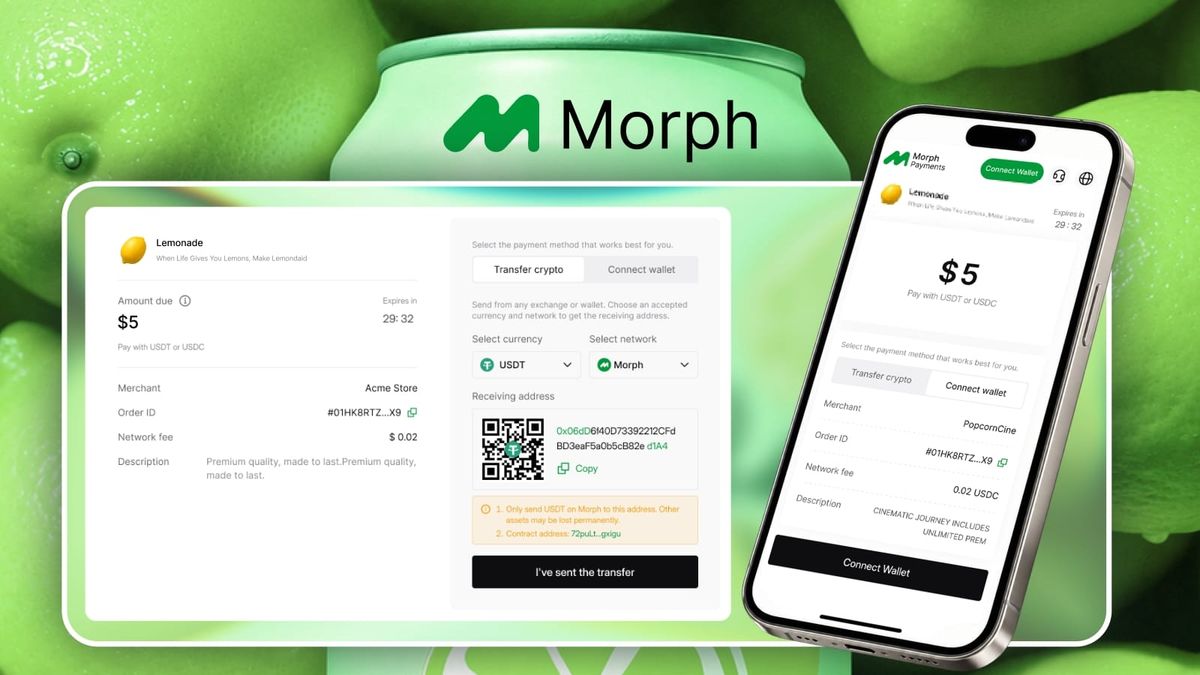
Morph Payments supports these stablecoin payment workflows through Payment Links, hosted checkout, and APIs. Businesses can accept supported USDT and USDC payments while using their own systems to manage orders and fulfillment.
For example, a merchant selling digital products through an independent website can create a payment request, direct the customer to checkout, and use payment confirmation events to update its order system.
The merchant remains responsible for its product delivery logic and any other services not provided by Morph.
Morph Payments is not a Merchant of Record or a complete Lemon Squeezy migration solution. It is an option for businesses that have independently decided to add stablecoin payments to their checkout.
For merchants serving customers who already use USDT or USDC, that distinction can be useful: payment collection can be evaluated separately from the rest of the commerce stack.
Considering stablecoin checkout for your digital store?
Book a demo with Morph Payments to discuss your payment requirements and integration options.
Your Lemon Squeezy migration checklist
Before switching providers, work through the areas most likely to affect existing customers and operations.
1. Export your business records.
Download the customer, product, order, subscription, and financial records you need to retain. Confirm what historical information will remain accessible after migration.
2. Review your active subscriptions.
Check renewal dates, payment methods, discounts, and whether customers will need to authorize a new billing arrangement. Do not assume every subscription can move automatically.
3. Protect existing product access.
If Lemon Squeezy currently handles license keys, download links, or file hosting, arrange a replacement before the original delivery system becomes unavailable.
4. Map every checkout integration.
Check your website, application, email campaigns, social profiles, product documentation, and any other places where Lemon Squeezy payment links appear.Include API integrations and webhooks used to update orders or customer accounts.
5. Test the full purchase process.
Run test purchases using the payment methods your customers actually use.Confirm that payment status is recorded correctly, orders are updated, products are delivered, and customers can access support if something goes wrong.
6. Check tax and compliance responsibilities.
If you're moving away from a Merchant of Record, establish which legal and tax obligations your business will assume. Payment processing alone does not automatically provide the same coverage.
7. Complete the migration before March 31, 2027.
Leave enough time to fix integration issues and notify customers before the shutdown. Lemon Squeezy recommends beginning the process no later than mid-January 2027.
Frequently asked questions
Can I continue accepting payments through Lemon Squeezy?
Yes. Existing stores can continue processing payments until March 31, 2027. All stores must migrate before that deadline, which Lemon Squeezy says will not be extended.
Will my Lemon Squeezy subscriptions transfer automatically?
Not necessarily.
Eligible card subscriptions can generally migrate to Stripe Managed Payments without requiring customers to re-enter payment details, but some payment methods require additional action.
PayPal subscriptions cannot migrate as PayPal subscriptions. Check the official migration tools and your new provider's requirements before making changes.
Can I move from Lemon Squeezy without using another Merchant of Record?
Yes, but you need to understand the implications.
A payment provider can handle payment processing without becoming the legal seller of your products. If you move away from a Merchant of Record, your business may become responsible for tax collection, reporting, and other applicable obligations that were previously handled by the MoR.
Can I use stablecoin payments instead of Lemon Squeezy?
Not as a complete replacement.Stablecoin payment solutions can help collect payments in supported digital assets, but they do not automatically provide tax management, subscription migration, software licensing, or digital fulfillment.
They are most relevant when your business already has those functions covered and wants to offer customers another way to pay.
Do I need to change my entire website?
Not necessarily.
You may be able to keep your existing website, catalog, and product delivery system while replacing checkout links or payment integrations.
The amount of work depends on which Lemon Squeezy features your store currently uses.
Make the migration decision around your business
Lemon Squeezy's shutdown creates a fixed deadline, but it doesn't mean every merchant needs the same replacement.
If your business depends on a Merchant of Record, preserving that arrangement may be essential. If you manage your own storefront and fulfillment, you may have more flexibility in choosing how payments are processed.
And if your customers already want to pay using stablecoins, this may be an opportunity to evaluate USDT or USDC checkout alongside your existing payment methods.
The priority is to keep your store working: customers should be able to pay, receive what they purchased, and continue using your product after the migration.