Morph and the Machine Economy

For most of human history, moving money required a person to authorize it. That is changing. AI agents are becoming economic actors, able to transact, pay for services, and settle with each other at any hour without human involvement.
This shift is one of the most significant changes in how value flows since the internet went mainstream, and it is the reason Morph is focused on building infrastructure purpose-built for the machine economy.
Why the Existing Financial System Cannot Serve Agents
Traditional financial infrastructure was designed for people. Every system in it assumes a human being sits at the center of every transaction, with legal identity, a jurisdiction, and documentation to match. Credit card networks are built for human cardholders. Settlement systems operate within business hours across time zones.
AI agents fit none of these requirements. A crypto wallet, by contrast, requires only a private key, which means an agent can hold value and move it without any of the identity overhead that legacy systems demand. It is one of the most important structural advantages that onchain infrastructure offers in an increasingly automated world.
Stablecoins are the natural currency for this economy. They carry no volatility risk, settle within seconds, and are programmable from the ground up. The emerging x402 payment standard builds on this by embedding payments directly into the HTTP protocol, so an agent can discover a price, authorize a payment, and receive a service in a single request that settles onchain in under 200 milliseconds. No account setup, no subscriptions, no manual billing cycles. Just a clean, machine-readable exchange of value.
What Agents Actually Need
Agents operating at scale have requirements that go well beyond what general-purpose infrastructure was designed to handle. Four things matter most.
Sub-cent economics. Legacy payment rails carry minimum fees that make anything below a few dollars economically irrational. Agentic commerce runs on payments far smaller than that. Fractions of a cent for a data request, a few cents for a compute call, sub-dollar micro-settlements between agent services. The fee structure of traditional rails makes the entire micropayment layer impossible.
Fast finality. An agent operating in a multi-step workflow cannot wait seconds for block confirmation between each action. Settlement needs to be fast enough that it disappears from the agent's operational awareness entirely.
Secure wallet architecture. Agents need wallets they can operate autonomously, but private keys must never be exposed to the model context window. Session-based wallets with defined spending limits, contract whitelists, and automatic expiration address this. The agent has exactly the permissions it needs and no more.
Verifiable identity. High-frequency agent-to-agent commerce requires that counterparties can verify who they are dealing with. A publicly observable reputation built from an on-chain transaction history is the trust layer that allows serious capital to flow between autonomous software.
Why Morph Is the Right Settlement Layer
Morph was built for high-volume, low-cost, real-world payment flows. The requirements of the agentic economy map directly onto the infrastructure decisions we have made from the beginning.
- Zero-fee stablecoin transfers mean USDC and USDT0 flows carry no per-transaction cost on Morph
- Sub-300 millisecond blocks bring settlement times into the range where agents experience them as instant
- Gas fees payable in stablecoins remove the token management complexity that makes agent treasury operations difficult to automate
- USDC and USDT0 are both live and operational on Morph today
- The x402 Facilitator is already running, allowing agents to submit transactions without holding gas
- Morph Skills gives any agent a single open-source integration for wallet creation, balance checks, stablecoin transfers, token swaps, and DeFi interactions
Our Agentic Roadmap
Morph's agentic infrastructure is rolling out across three phases through the first half of 2026. Each phase extends the stack, taking agents from basic onchain operations through to a fully functioning agentic economy layer.
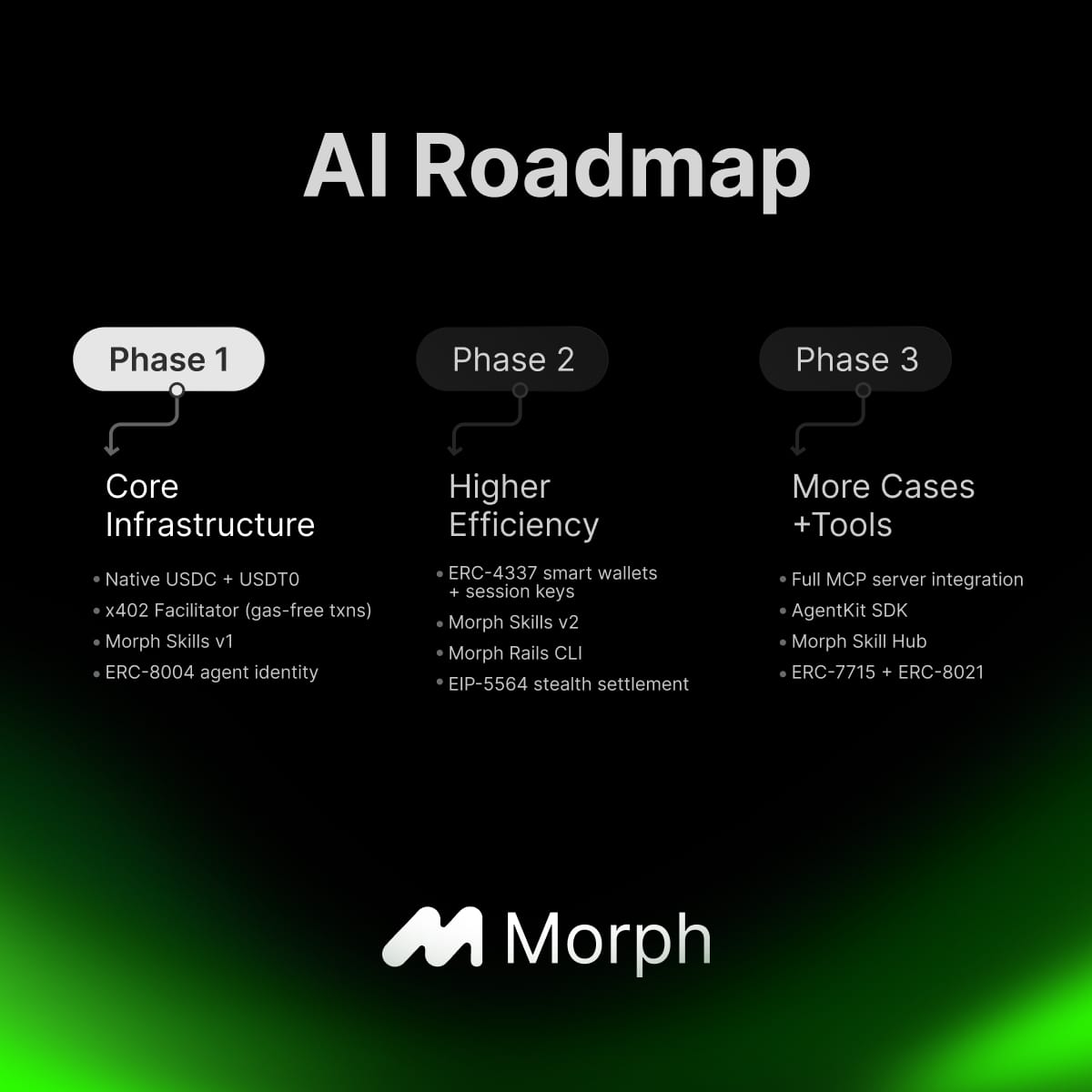
Phase 1: Core Infrastructure
The first phase covers everything an agent needs to operate and transact on Morph today.
- USDC and USDT0 live on mainnet
- x402 Facilitator for gas-free agent transactions
- Morph Skills v1 for wallet creation, balance checks, stablecoin transfers, and token swaps
- ERC-8004 verifiable agent identity on mainnet
Phase 2: Higher Efficiency
The second phase addresses the higher-level needs of agents operating across a more complex payments landscape.
- ERC-4337 abstract accounts for session-based smart wallets with programmable spending controls
- Morph Skills v2 with smart wallet creation, cross-chain bridge support, and DeFi protocol integration
- Privacy-preserving transactions via EIP-5564 for stealth settlement
- Morph rails CLI v2 for swap, bridge, DeFi, and on-chain identity operations
Phase 3: More Cases and Tools
The third phase opens the ecosystem to a broader agentic economy, where agents can discover services, earn from their work, and collaborate across a growing network.
- Full MCP server integration for natural language queries and execution across on-chain data
- AgentKit SDK for developers building agent-native applications
- Morph Skill Hub for discovering and sharing agent tool packages
- ERC-7715 for wallet permission delegation
- ERC-8021 for transaction attribution
The full stack runs from the Morph SDK at the base, through Morph Skills, Payment CLI, and HTTP API as developer-facing interfaces, up to the MCP Server as the AI-native integration layer. The design intent is that agents plug in using whatever framework they already work with, without needing a custom integration for every new use case.
The Opportunity Ahead
Agentic commerce is still early. The volumes transacting through on-chain agent infrastructure today are a fraction of what they will become, and that is precisely why the infrastructure decisions made right now will carry so much weight.
Morph has spent the past year building the settlement layer for global payments. The properties required for that work are the same properties the agentic economy needs. Fast finality, low fees, stablecoin-native flows, real-world payment network integrations, and a developer toolkit that makes it straightforward to build on top of it all.
The machine economy is coming and Morph is building the rails to run it on.
Money at the speed of life. Now at the speed of machines.
Start building at github.com/morph-l2/morph-skill or reach out to the Morph team directly.